

CVEs and VEX
Trowl matches userland components and the kernel against CVE version ranges. For kernel CVEs, --kernel-tree also checks whether your build includes the affected code, and applies VEX.
Data sources
Section titled “Data sources”| Source | Used for | Fetched from |
|---|---|---|
NVD |
CVE records, CVSS and CPE ranges | NVD JSON feed mirror with one file per year |
Kernel CNA |
Kernel version ranges, stable backports and affected source files | Kernel CNA records in the NVD feed mirror |
CISA KEV |
Known exploited CVEs | cisagov/kev-data with cisa.gov as a fallback |
EPSS |
Exploit probability | Daily EPSS score file |
The detail panel links to NVD, OSV and cve.org. Kernel CVEs also link to vulns.git. These references do not supply matching data.
Caching
Section titled “Caching”Trowl caches downloaded data and link-check results, usually in ~/.cache/trowl. Online scans refresh stale data and use an existing cached copy if a download fails.
See Data fetching and caching for details.
Userland CVEs
Section titled “Userland CVEs”With --sbom, Trowl reads components and their CPEs from the SBOM to perform version matching. See SBOM analysis.
Without an SBOM, Trowl tries package databases first and falls back to fingerprints.
Package database
Section titled “Package database”Trowl uses source package names where available and removes epochs and packaging revisions to match upstream releases. For example, 1:2.36-r0 becomes 2.36.
Databases are checked in this order:
| Database | Location |
|---|---|
opkg |
/var/lib/opkg/status or /usr/lib/opkg/status |
dpkg |
/var/lib/dpkg/status |
rpm |
rpmdb.sqlite under /var/lib/rpm or /usr/lib/sysimage/rpm. Requires sqlite3 on the host. |
Fingerprinting
Section titled “Fingerprinting”Minimal images often leave out the package database. Yocto’s core-image-minimal, for example, can be built without the package-management image feature.
A fingerprint is a YAML rule that recognises one upstream package from its binaries and reads the version from them.
- Only ELF files up to 64 MiB are read. Symbolic links are skipped, since the file they point to is read under its own name.
- A source-control suffix such as
+gitis dropped from the version, because CVE records don’t use it. - Two versions of the same package, such as two copies of a library, become two components.
Coverage is currently limited to the packages below. Contributions are welcome.
| Component | What Trowl reads |
|---|---|
busybox |
The BusyBox vX.Y.Z banner |
glibc |
The GNU C Library ... release version string in libc |
openssl |
The OpenSSL X.Y.Z version and build date in libcrypto |
openssh |
The OpenSSH_X.YpZ banner |
zlib |
The deflate and inflate copyright strings |
util-linux |
The util-linux X.Y string, the libblkid release date or a debug path |
kmod |
The kmod version string or a debug path |
sysvinit |
The INIT_VERSION=sysvinit- string |
acl attr xz |
The version in the shared library’s file name |
eudev libxcrypt shadow tar |
The /usr/src/debug/<package>/<version>/ path left by the build |
Adding a fingerprint
Section titled “Adding a fingerprint”Each package has one YAML file in Fingerprints. For example:
package: opensshcpes: [cpe:2.3:a:openbsd:openssh]evidence: - files: [sshd, ssh.*] pattern: '\x00OpenSSH_(?P<version>\d+\.\d+p\d+)\x00'examples: - file: sshd contains: "command-line\0OpenSSH_10.3p1\0%s, %s" version: 10.3p1rejects: - file: sshd contains: "\0OpenSSH_3.*\0"Scan fields
Section titled “Scan fields”| Field | Required | Meaning |
|---|---|---|
package |
Yes | The name shown in the report |
cpes |
Yes | The CPEs to look up CVEs with, written as cpe:2.3:<part>:<vendor>:<product> without a version. Add one for each vendor name CVEs use, or use * for any vendor |
evidence |
Yes | A list of entries, each with the files to read and a pattern or name_pattern. Entries are tried in order, and the first match wins |
evidence[].files |
Yes | Which files to read, as name globs in path.Match syntax. They match in any directory |
evidence[].pattern |
Yes, unless name_pattern is set |
A regex that finds the version in the file’s contents. Capture it in a version group, or in major, minor and patch groups when the digits are packed together |
evidence[].name_pattern |
Instead of pattern |
Use this when the version is in the file name. For example, acl’s libacl.so.1.1.2302 gives 2.3.2. The file still has to be an ELF binary |
Test fields
Section titled “Test fields”go test ./internal/inventory/ uses these inputs to test fingerprints. They do not take part in scan detection.
| Field | Required | Meaning |
|---|---|---|
examples |
Yes | Inputs that must give a version. Add one for each evidence entry |
examples[].file |
Yes | File name the input stands for |
examples[].contains |
Yes | Bytes copied from a real binary |
examples[].version |
Yes | Version the fingerprint must return |
rejects |
No | Inputs that must give no version, with the same fields minus version |
Keep regexes in single quotes so YAML leaves their escapes alone. Put sample bytes in double quotes, where \0 and \x0a become real bytes.
Adding a package
Section titled “Adding a package”- Find the version string in a real binary with
stringsorgrep -a -o. - Write
<package>.yamland copy the bytes around the version intoexamples. - Run
go test ./internal/inventory/. - Rebuild Trowl, which embeds the fingerprints at build time.
All fingerprints are validated when loaded. Missing required fields, malformed CPEs or missing version captures stop fingerprinting for the whole scan.
Matching
Section titled “Matching”Trowl matches CPE product and version against CVE records and skips rejected CVEs. Vendor checks depend on the component source.
| Component source | Matching |
|---|---|
| SBOM with CPE | Vendor checked unless it is *. Wildcard matches use only the product name and show the CVE ID in yellow |
| SBOM without CPE | Not matched |
| Package database | Package name only since the database records no upstream vendor |
| Fingerprint | Vendor checked unless the fingerprint’s CPE gives * |
Vendor check
Section titled “Vendor check”- CNA records. Trowl drops suffixes such as “Inc.” and “Project” and accepts names that contain one another. The OpenSSL CNA’s “The OpenSSL Project” matches
openssl. - NVD configurations. The CPE vendor must match exactly.
Trowl always prefers a CNA match, except when:
Section titled “Trowl always prefers a CNA match, except when:”- The vendor doesn’t match. The CNA entry may be for another project with the same name. Yocto’s SBOM gives OpenSSL the CPE
openssl:openssl. CVE-2023-53159 has a CNA entry for productopensslfrom vendorsfackler, which is the Rustopensslcrate. The vendors don’t match and NVD doesn’t listopenssl:opensslfor it, so the CVE isn’t reported. - The versions are written as text. CVE-2016-7837 says BlueZ “5.41 and earlier”. Text can’t be compared, so NVD’s range up to 5.41 applies.
- There’s no version to compare, such as a git commit or “n/a”.
Version matches appear as Affected unless the SBOM or a VEX file supplies a status. See How Trowl reads each format.
Kernel CVEs
Section titled “Kernel CVEs”Version matching
Section titled “Version matching”Kernel matches use the CNA’s affected ranges for each stable series. NVD’s CPE configurations are the fallback when no usable CNA ranges are available.
With an SBOM, the version comes from its kernel component. Otherwise, Trowl uses the first available source:
- The kernel config header
- The
/lib/modules/<release>directory name - The installed kernel package version
A version match identifies a potentially affected release. The source check below determines whether the affected code is compiled or shipped.
Kernel VEX assessment works with or without an SBOM. Trowl can recheck VEX statuses supplied by the SBOM to rule out false positives.
Kernel tree analysis
Section titled “Kernel tree analysis”The kcond fork reads the kernel’s build rules (Kbuild) and option definitions (Kconfig). For each file (.c, .h) named in the kernel CNA record, Trowl finds the config gates that compile it and the module it builds into. For example, CVE-2026-74752 names these two files:
| File | Build Conditions | Builds into |
|---|---|---|
net/sctp/auth.c |
CONFIG_IP_SCTP && CONFIG_NET |
sctp.ko when CONFIG_IP_SCTP=m |
include/net/sctp/auth.h |
CONFIG_DLM || (CONFIG_IP_SCTP && CONFIG_NET) || CONFIG_SECURITY_SELINUX |
Each file that includes it |
Trowl then checks whether the supplied kernel config, or the image’s config, satisfies one of the gates. For a modular gate, it also checks whether the module is installed. In the Wrynose test image, CONFIG_IP_SCTP=m but sctp.ko isn’t installed, so auth.c doesn’t ship.
No rebuild or SBOM list of compiled sources is required. This works with Yocto SBOMs that omit that list.
Requirements
Section titled “Requirements”| Input | Requirement |
|---|---|
--kernel-tree DIR |
Match the image’s kernel release. A top-level Makefile mismatch stops the scan. |
--kernel-config FILE |
Full .config only if the image has neither /boot/config-* nor an embedded config. Defconfigs omit defaults and are rejected. |
File results
Section titled “File results”| Result | Meaning |
|---|---|
Compiled |
Built into the kernel or a shipped module. A .h file counts when included by compiled source. |
Module not shipped |
Built only into modules absent from /lib/modules. |
Not compiled |
Disabled by config or excluded for another architecture. For an existing header, no compiled source includes it. |
Unknown |
A build condition cannot be resolved or a source file has no build rule. Missing source files remain Unknown unless their directory is known to compile no code. |
When config enables a file, uncertain kernel or module linkage is kept as Compiled. Makefiles, Kconfig files, documentation and tools are skipped.
VEX assessment
Section titled “VEX assessment”Trowl assigns VEX only to kernel CVEs. Userland CVEs keep their SBOM or VEX file status, or Affected from version matching.
CVE verdicts
Section titled “CVE verdicts”The first matching row applies. For Not affected, the second line gives the OpenVEX justification.
| First Match | Verdict |
|---|---|
Any Compiled |
Affected |
Any Unknown |
Needs review unless the SBOM already says Affected |
Any Module not shipped |
Not affectedcomponent_not_present |
All Not compiled |
Not affectedvulnerable_code_not_present |
CVEs with no listed files or only skipped paths keep their status without a new verdict.
Yocto’s sbom-cve-check may mark a CVE Ignored when its files are absent from the build. If the version is affected but exclusion cannot be confirmed, Trowl uses Needs review because the files may have moved or been renamed. These cases appear under Disagreements.
Disagreements
Section titled “Disagreements”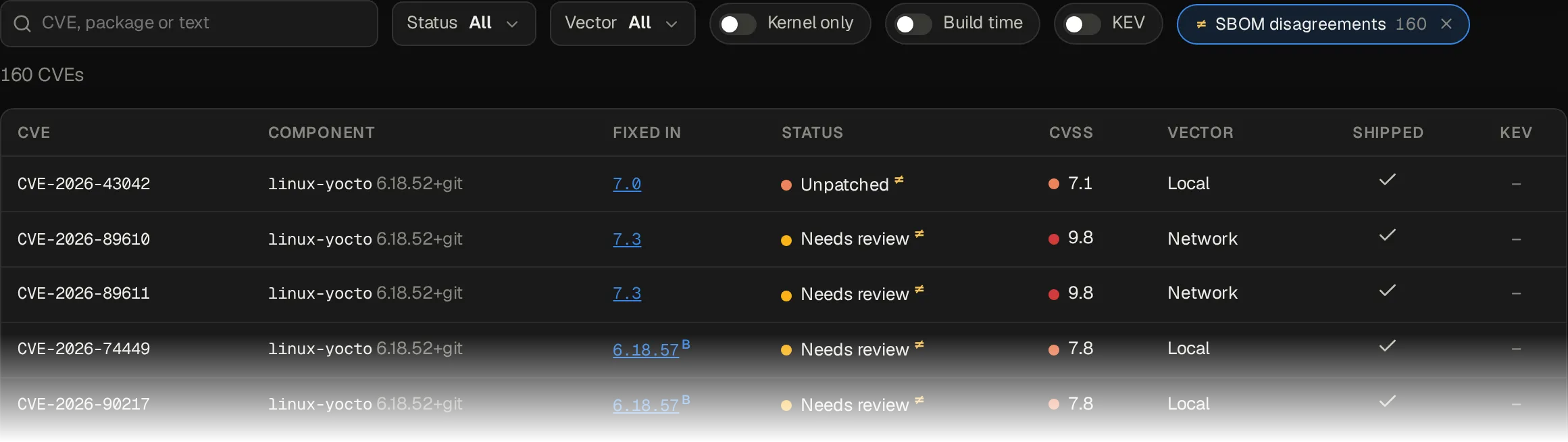
Existing VEX statuses are handled as follows, with examples from a Yocto sbom-cve-check SPDX 3.0.1 SBOM. The same rules apply to CycloneDX.
| SBOM status | Trowl’s Action | Example |
|---|---|---|
Fixed |
Keeps it unchanged, compiled code may already contain the fix. | None. Fixed is never changed |
Not affected |
Recheck only config exclusions for affected versions. These use the not-applicable-config status note in Yocto SPDX 3.0 from sbom-cve-check or the code_not_present justification in CycloneDX. Otherwise keep the status. |
Becomes Affected if the code is compiled, or Needs review if the version is in range but the affected files aren’t in the tree (e.g. because they were renamed) |
AffectedUnder investigationUnknown |
Checks the code and applies the verdict above. | Affected becomes Not affected, for example when a module isn’t shipped |
A VEX file works differently. Its status stays and Trowl only flags the disagreement, unless --override is passed.
Where the verdicts go
Section titled “Where the verdicts go”Verdicts appear in the dashboard, in report.json and in openvex.json, which every scan writes beside the report. See OpenVEX output.
VEX files
Section titled “VEX files”Pass your own triage, or a supplier’s statements, with --vex. Trowl reads OpenVEX (v0.2.0 and the older v0.0.x) and CycloneDX VEX JSON.
trowl scan image.rootfs.ext4 --sbom image.spdx.json --kernel-tree linux --vex triage.openvex.json -o reportAn OpenVEX file updates statuses for CVEs Trowl has already found. It does not add CVEs and works with or without –sbom. For CycloneDX VEX, see Separate VEX files.
Linking statements to components
Section titled “Linking statements to components”Trowl links an OpenVEX product to a component by the first identifier that matches.
| Order | Identifier | Matches when |
|---|---|---|
| 1 | SBOM ID | The product’s @id is an SPDX element ID or a CycloneDX BOM-Link in the SBOM |
| 2 | PURL | Type, namespace, name and version agree. Qualifiers are ignored, and a PURL without a version matches every version |
| 3 | CPE | Vendor, product and version agree. A * matches anything |
| 4 | Name and version | The name and version from a PURL, a CPE or name@version equal the component’s. Without an SBOM, Trowl drops the epoch and packaging revision first |
A product with subcomponents is the image, so Trowl matches only its subcomponents. This is how Grype and Trivy write statements for an image. A statement on a Yocto binary package also covers the recipe that carries its CVEs.
When several statements cover the same CVE on a component, the newest one wins. The scan output counts statements for CVEs Trowl didn’t find and for components that aren’t in the image. A file where no statement names a component in the image stops the scan.
Precedence
Section titled “Precedence”The first source in this table that covers a CVE sets its status.
| Source | Wins over |
|---|---|
VEX file (--vex) |
The SBOM’s own VEX, Trowl’s kernel verdict and version matching |
Trowl’s kernel verdict (--kernel-tree) |
The SBOM’s own VEX and version matching |
| The SBOM’s own VEX | Version matching |
| Version matching | Nothing. It gives Affected |
When Trowl’s kernel verdict contradicts a VEX file, the file’s status stays and the row gets a yellow ≠. The CVE overlay shows Trowl’s verdict and the files behind it. Trowl only contradicts a statement about kernel code being built:
affected, when Trowl finds the code not compiled or its module not shippednot_affectedwithvulnerable_code_not_presentorcomponent_not_present, when Trowl finds the code compiled
Other statements, such as not_affected with inline_mitigations_already_exist, make claims Trowl doesn’t check.
No standard sets the order between VEX inside an SBOM and a separate VEX file. Trowl treats the file as the more deliberate decision, the way Trivy and Grype let a VEX file override their own findings.
Letting Trowl’s kernel check win
Section titled “Letting Trowl’s kernel check win”With --override, Trowl’s kernel verdict replaces a VEX file’s status wherever the two disagree as described above. The row shows Trowl’s verdict first and the file’s status below it.
trowl scan image.rootfs.ext4 --sbom bom.json --kernel-tree linux --vex vex.json --override -o reportUse it for VEX that the build generates rather than a person, such as the cve-check results Yocto’s meta-cyclonedx writes. Userland CVEs always keep the file’s status, because a version match can’t see a patch that was backported without a version change.